The Golden Spiral: Creating Art That Feels Naturally Beautiful

Updated: Aug 30

Rejuvenation |
Have you ever looked at a painting and felt immediately drawn into it—without quite knowing why?
Sometimes it is the color. Sometimes it is the subject. But often, what we are responding to is composition: the invisible structure that guides our eyes through a work of art.
One of the most enduring compositional ideas is the Golden Spiral, a visual pattern connected to the Golden Ratio. It appears throughout nature—in shells, flower formations, unfurling ferns, hurricanes, and even the way branches and leaves can organize themselves.
For artists, the Golden Spiral can be a beautiful tool for creating work that feels balanced, organic, and naturally pleasing without feeling rigid or overly designed.
What Is the Golden Spiral?
The Golden Spiral is based on the Golden Ratio, approximately 1:1.618.
It can be visualized by dividing a rectangle into increasingly smaller sections and drawing a curve through those sections. The resulting spiral creates a path that moves from a broad outer area toward a tighter focal point.
What interests me most as an artist is not the mathematics itself. It is the way the spiral mirrors movement we already recognize in nature.
Our eyes understand it intuitively.
That means the Golden Spiral can become a subtle roadmap for arranging flowers, branches, figures, landscapes, or abstract shapes within a painting.
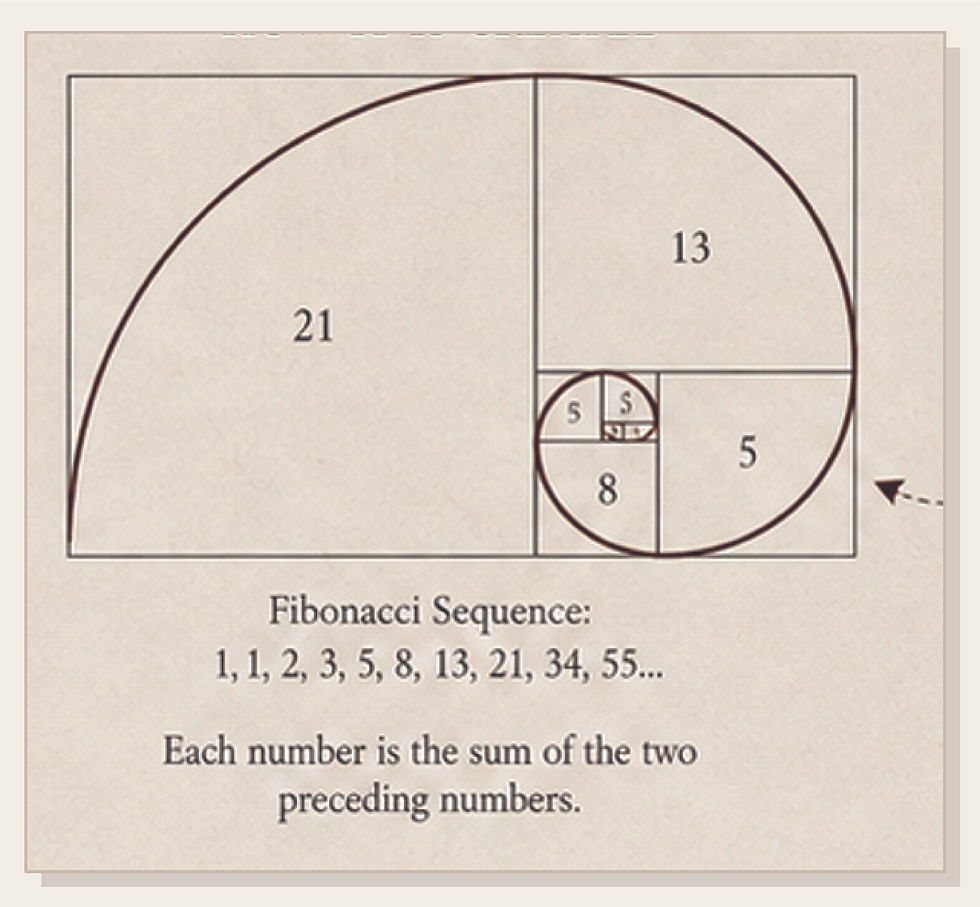

Composition Is About Movement
When I first began thinking about the Golden Spiral, I looked at one of my floral compositions differently.
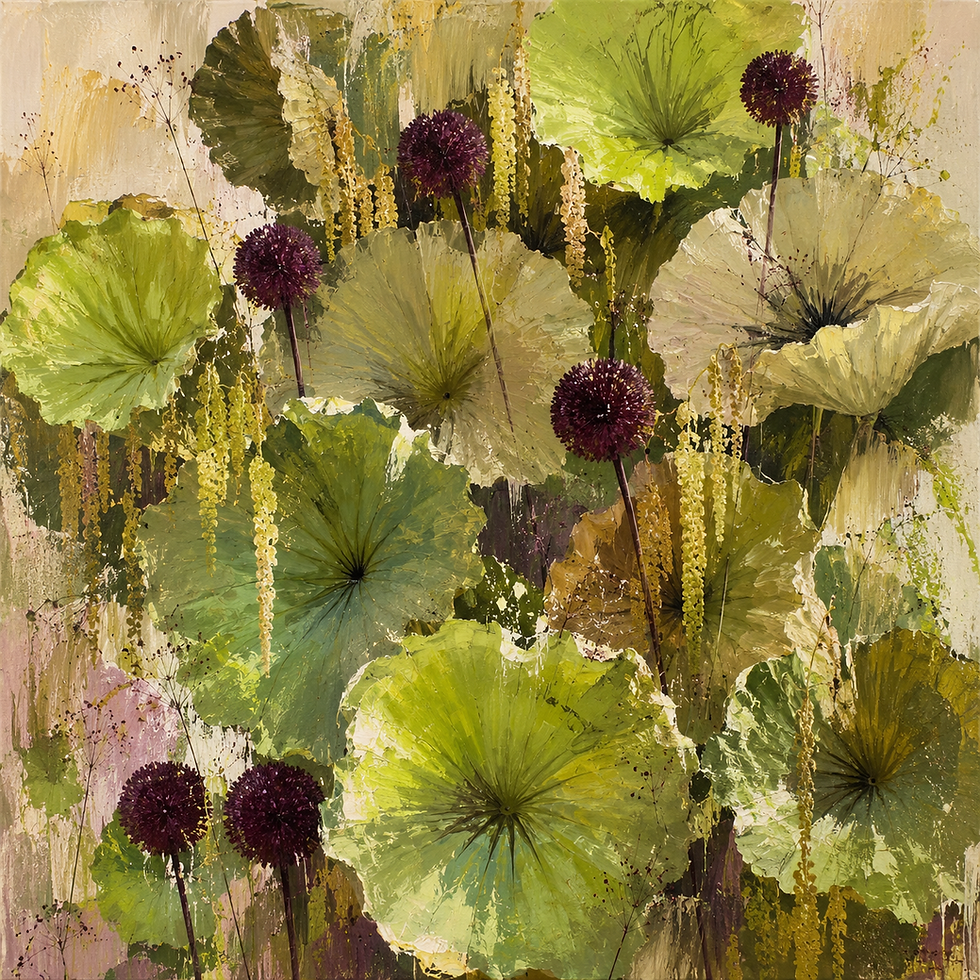
The painting included large chrysanthemums, delicate purple flowers, spotted begonia leaves, ferns, and loose branches against a textured neutral ground.
The elements themselves worked beautifully, but many of the strongest flowers were concentrated near the center of the canvas. The composition felt balanced, yet relatively static.
By imagining a Golden Spiral across the canvas, another possibility emerged.
Instead of asking:
Where should I place the flowers?
I began asking:
How do I want the viewer's eye to travel through the painting?
That small shift changes everything.
Creating a Visual Journey
A Golden Spiral composition usually benefits from having a clear hierarchy.
One element becomes the primary focal point. Secondary elements support it. Smaller details help move the viewer from one area of the painting to another.
In a floral composition, for example, the eye might enter through a sweeping branch in the upper corner, move toward a large white chrysanthemum, travel across a deep plum bloom, continue toward a softer lavender flower, and finally resolve through trailing foliage or fern leaves.
Rather than seeing the entire arrangement at once, the viewer experiences the painting gradually.
There is a beginning, a journey, and a resting point.
The Power of Negative Space
One of the most important lessons I continue to learn in painting is that composition is not only about where you put things.
It is also about where you don't put things.
Negative space gives the eye somewhere to rest.
When every part of a canvas carries equal visual weight, the viewer does not know where to look first. A generous area of quieter background can make the painted elements feel dramatically stronger.
This is especially compatible with the wabi-sabi influence I love in art—the appreciation of asymmetry, restraint, imperfection, and breathing room.
The Golden Spiral naturally encourages this kind of balance.
Instead of evenly filling a canvas, the composition can feel weighted toward one area while still remaining harmonious.
Think in Terms of Hierarchy
A simple way to use the Golden Spiral is to establish three levels of importance.
Your primary element should command attention.
Your secondary element should reinforce the direction of the composition.
Your tertiary details—leaves, stems, small blossoms, texture, marks—should help connect the larger forms.
In one of my floral studies, I imagined the hierarchy as:
White chrysanthemum → deep plum chrysanthemum → lavender chrysanthemum → foliage
The flowers do not need to be equal in size or intensity.
In fact, they are often more interesting when they are not.
Scale, contrast, color, and placement can all help establish the order in which the viewer experiences the work.
Let Nature Be Irregular
One of the easiest traps in floral painting is accidental symmetry.
Flowers naturally tempt us to create a bouquet shape: one bloom here, another there, foliage evenly distributed around them.
But nature rarely feels perfectly balanced.
Branches reach unexpectedly. Flowers overlap. Leaves disappear behind one another. Some areas are dense while others are almost empty.
The Golden Spiral can provide enough structure to keep the composition visually sound while still allowing the painting to feel spontaneous.
It gives us a framework without requiring perfection.
And for a loose, expressive painting style, that balance is especially useful.
You Don't Have to Draw the Spiral
You certainly can lightly sketch a Golden Spiral over a reference image or canvas during the planning stage.
But eventually, the goal is to begin seeing the movement without needing the diagram.
Ask yourself:
Where does my eye enter the painting?
Where does it go next?
What is the strongest focal point?
Are several elements competing for attention?
Is there enough negative space?
Does the composition lead the viewer somewhere—or simply hold everything in place?
These questions can be more useful than trying to mathematically calculate every placement.
A Tool, Not a Rule
Perhaps the most important thing to remember is that the Golden Spiral is not a formula for making good art.
Art should never feel like solving an equation.
The spiral is simply one compositional tool among many.
Sometimes the most compelling painting will deliberately break every traditional compositional rule.
But understanding tools like the Golden Ratio gives us more control over when we follow those rules—and when we choose to abandon them.
For me, that is where artistic intuition becomes especially interesting.
We begin with structure.
We observe.
We adjust.
And eventually, we learn to trust our eye.
Finding the Balance Between Intuition and Intention
Much of painting feels instinctive.
A flower moves slightly to the left. A branch stretches farther than expected. A patch of background stays untouched because something tells you it should.
The Golden Spiral helps explain why some of those instinctive choices work.
It reminds me that a compelling composition can feel both intentional and effortless.
The viewer should not necessarily recognize the spiral.
They should simply feel that their eye wants to move through the painting.
That the composition breathes.
That the elements belong together.
And sometimes, the most beautiful structure in art is the one the viewer never consciously sees.

Comments