The Beauty of Imperfection: How Wabi-Sabi Art Changes the Feeling of a Space

There is something powerful about a room that doesn’t feel overly finished.
A worn wooden table. Handmade pottery with an irregular edge. Linen that wrinkles instead of resisting it. A branch clipped from the garden rather than a perfectly arranged bouquet. And on the wall, a painting where every brushstroke hasn’t been polished away.
These are the spaces that invite us to stay.
That feeling sits at the heart of wabi-sabi, the Japanese philosophy of recognizing beauty in imperfection, impermanence, simplicity, and the natural passage of time. And while we often associate wabi-sabi with interiors, ceramics, or architecture, I find its philosophy especially meaningful when applied to art.
Art Doesn't Have to Be Perfect to Be Beautiful
As an artist, one of the hardest—and most freeing—things to learn is when to stop.
There is always another detail that could be added. Another edge that could be refined. Another petal that could be made more realistic.
But sometimes, in trying to perfect a painting, we paint away the very thing that gave it life.
Wabi-sabi offers another way of looking at beauty.
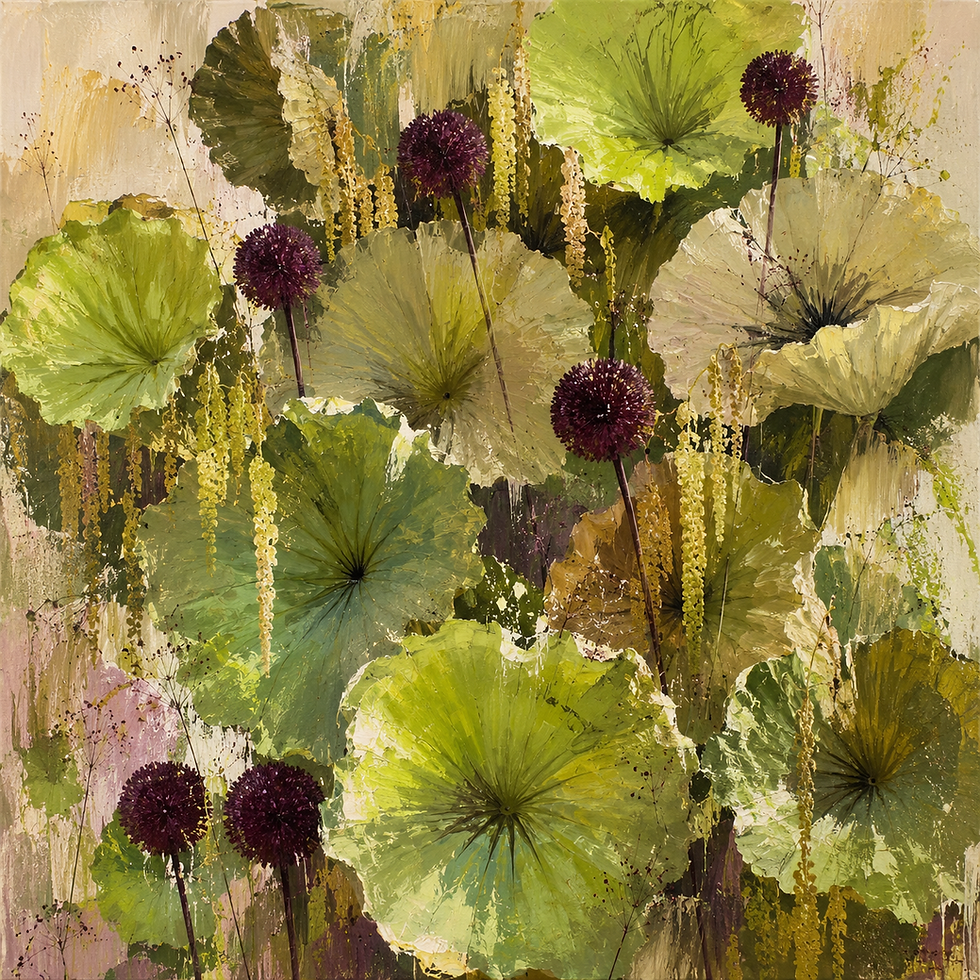
A visible brushstroke can be beautiful because we can see the hand that made it. A drip can become evidence of movement. An unfinished edge allows our imagination to complete what isn't there. Layers showing through one another tell the story of how the painting evolved.
The imperfections aren't necessarily mistakes to correct.
They are evidence that something was made.
That idea has become increasingly important in the way I approach my own loose acrylic paintings. I don't want to paint every petal or leaf exactly as nature created it. I'm more interested in capturing what it felt like to see it.
Leaving Room for the Painting to Breathe
One of my favorite principles within wabi-sabi is the appreciation of emptiness.
In Western decorating, we can have an instinct to fill space. Empty walls need artwork. Empty corners need furniture. Empty areas within a painting need another flower, another branch, another mark.
But empty space isn't necessarily something missing.
Sometimes it is what allows everything else to become more important.

In a botanical painting, negative space gives a single stem significance. It allows an irregular branch to become almost sculptural. It gives your eye somewhere to rest before returning to the more detailed areas of the composition.
The same thing happens within a room.
When one meaningful painting is given space around it, you experience it differently. You notice its texture. Its scale. Its irregularities. The subtle colors that might disappear in a busier environment suddenly become visible.
The room becomes quieter—and the artwork becomes stronger.
Nature Is Imperfectly Balanced
Nature rarely arranges itself symmetrically.
Branches lean toward light. Flowers overlap. One side of a plant grows fuller than another. Leaves curl, fade, fall, and regenerate.
And somehow it all feels balanced.
That observation has influenced the botanical compositions I've been exploring. Rather than building perfectly centered floral arrangements, I'm drawn to flowers that emerge from one side of a canvas, stems that wander into open space, foliage that disappears beyond an edge, and unexpected relationships between large blooms and tiny ones.
The composition doesn't have to be symmetrical to feel harmonious.
Balance can come from tension, movement, scale, color, and space.
There is tremendous freedom in that.
The Materials Matter, Too
Wabi-sabi isn't only about what we paint. It can also influence how we paint.
I love surfaces where you can see what happened before the final layer.
A little raw ground showing through.
Scraped paint.
Transparent washes beneath heavier acrylic.
Dry brush marks.
An imperfect line.
A drip allowed to remain.
A place where the original sketch is still barely visible.
These details give a painting history.
Instead of presenting a flawless surface, the artwork reveals its making. From across the room, you experience the composition. As you move closer, you discover another landscape of marks, textures, and layers.
That discovery is part of what makes original art so different from purely decorative imagery.
What Wabi-Sabi Art Does to a Room
The most interesting thing may be what happens when this kind of artwork enters an interior.
Wabi-sabi art doesn't demand that everything around it match.
In fact, it becomes more beautiful when surrounded by things that also possess character: warm wood, aged brass, handmade ceramics, linen, stone, plaster, woven fibers, vintage furniture, and objects collected over time.
And this doesn't mean your home has to be entirely wabi-sabi.
I especially love seeing these ideas mixed with mid-century modern design. The clean architecture and warm woods of mid-century furniture provide structure, while expressive botanical art introduces softness and movement. Add an imperfect ceramic vessel, a few branches, natural linen, and something vintage, and suddenly the room feels collected rather than designed all at once.
The artwork becomes a bridge between structure and nature.
Quiet Luxury Is Personal
We hear the phrase quiet luxury often in design, but for me, true quiet luxury isn't about how expensive something is.
It's about choosing fewer things with more meaning.
An original painting carries evidence of another person's hand. You can see decisions, revisions, hesitation, confidence, and movement embedded within its surface.
No two marks are exactly alike.
That imperfection creates intimacy.
And when we surround ourselves with objects that carry those qualities, our homes begin to feel less like showrooms and more like reflections of our lives.
Painting What You Feel, Not Everything You See
Perhaps this is what I love most about connecting wabi-sabi philosophy with painting.
It gives us permission to loosen our grip on perfection.
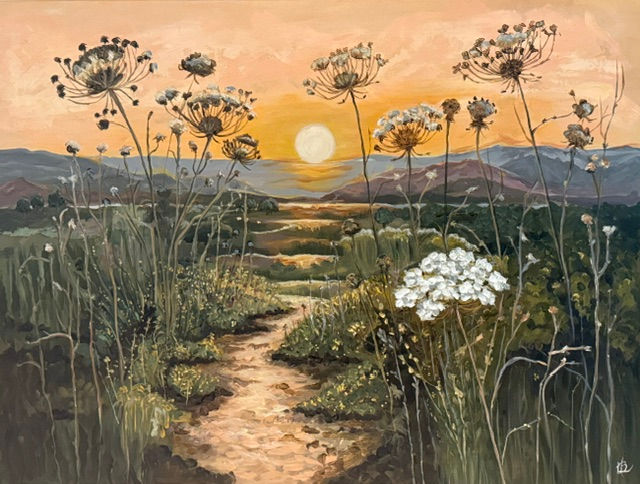
A flower doesn't have to contain every petal to feel like a flower. A branch doesn't have to be botanically precise to communicate movement. A landscape doesn't need every tree.
Sometimes one gestural mark tells the story better than twenty carefully rendered ones.
I'm learning that painting can be as much about editing as adding—knowing what to describe and what to merely suggest.
And perhaps creating a beautiful home works the same way.
Leave something unfinished.
Leave somewhere for your eye to rest.
Choose the object with character instead of the flawless one.
Hang the painting that makes you feel something rather than the one that simply matches the sofa.
Because wabi-sabi reminds us that beauty isn't found in making everything perfect.
Sometimes beauty appears when we finally stop trying to.
— Burns Artiste


Comments