Painting the Feeling of a Place

Updated: Aug 30
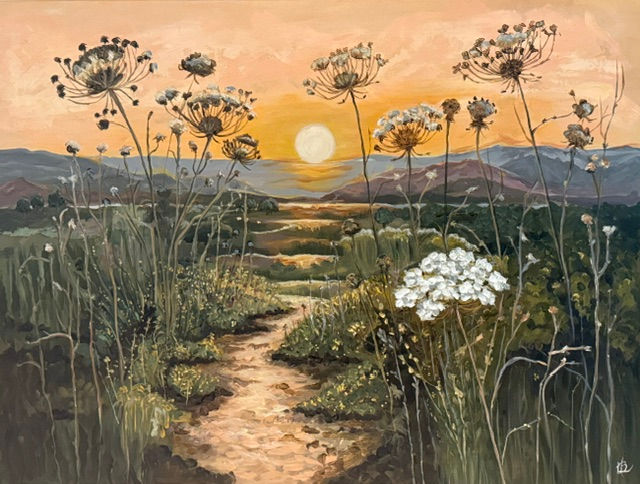
Why a landscape doesn’t have to tell you everything to take you somewhere
There is a moment when I’m painting a landscape when I have to stop looking at what is actually there.
Not because the details don’t matter, but because if I try to paint every tree, every blade of grass, every flower and every change in the horizon, I can lose the thing that made me want to paint the scene in the first place.
The feeling.
I’m becoming increasingly interested in landscapes that don’t simply show you a place. I want them to make you remember one.
Maybe it’s somewhere you’ve been a thousand times. Maybe it’s somewhere you’ve never been at all. But something about the light, the color of the sky, the bend in a path or the way wildflowers disappear into shadow feels strangely familiar.
That, to me, is where landscape painting becomes interesting.
Painting what you feel, not everything you see
When we look at a landscape, our eyes technically see thousands of individual pieces of information. But that isn’t necessarily how we experience it.
We remember impressions.
The warmth of late-afternoon sun.
A field turning almost black as the light falls behind it.
The silvery color of water just before dusk.
Wildflowers silhouetted against a pale sky.
A path disappearing around a bend.
The hazy blue-gray shape of hills in the distance.
So when I paint, I’m learning to ask myself a different question.
Not “How do I reproduce this scene?”
But rather:
“What was it about this place that made me stop?”
Once I know that, everything else can become secondary.
A flower can be a few marks. A distant tree can become a shape. A hillside might be nothing more than two colors meeting each other.
The painting doesn’t have to explain everything.
In fact, sometimes the less it explains, the more room there is for the viewer to enter it.
Shadow is just as important as light
I used to think beautiful landscapes were primarily about capturing beautiful light.
Now I think they are just as much about protecting the shadows.
Light only feels luminous when something around it is darker.
A glowing horizon becomes more powerful when the meadow beneath it falls into deep olive, charcoal and umber. A white flower seems almost illuminated when it emerges from a shadowed field. A reflection on water becomes brighter when surrounded by cool gray-blue.
That contrast creates atmosphere, but it also creates emotion.
And I love letting some areas become almost indistinct.
There might be flowers hidden in the darkness that you can barely see. Grasses dissolve into one another. A distant tree becomes little more than a silhouette.
Your eye doesn’t need all the information.
It completes the story.
Creating a way into the painting
There is something wonderful about a landscape that makes you feel as though you could walk into it.
I often find myself drawn to paths, rivers, shorelines and openings between grasses because they naturally invite the eye forward.
A path can begin at the bottom of a canvas and disappear into the distance.
A river can catch a streak of sunlight and quietly carry your eye toward the horizon.
Wildflowers can stand close to you in the foreground while distant hills dissolve into atmospheric color.
These elements create depth, but more importantly, they create possibility.
You begin imagining what might be beyond the bend.
And suddenly you are no longer simply looking at a painting.
You are somewhere inside it.
Letting the paint behave like paint
One of the things I love most about working loosely in acrylic is allowing the marks themselves to remain visible.
A scrape of paint can become a hillside.
A dry brush can suggest grasses.
A palette knife can create the shimmer of water.
A few imperfect lines can become stems moving through a meadow.
I don’t necessarily want every mark to disappear into realism. I want you to be able to get close to the painting and see the decisions—the layering, scraping, changing direction and moments when one color unexpectedly meets another.
From across the room, you see a landscape.
Up close, you see paint.
I love that tension.
It gives the work life.
The beauty of the imperfect landscape
Nature itself isn’t particularly interested in perfect composition.
Flowers lean.
Grasses cross one another.
Seed heads dry and curl.
Branches interrupt views.
Plants grow in inconvenient places.
And somehow it all works.
That imperfection has become an important part of how I want to paint landscapes. There is a wabi-sabi quality to allowing things to feel slightly unresolved, weathered or asymmetrical.
Not every corner needs something happening.
Not every flower needs to be finished.
Not every horizon needs to be perfectly defined.
Sometimes an empty stretch of sky is exactly what a painting needs.
Sometimes one awkward stem stretching higher than everything else gives the entire composition its personality.
The challenge is knowing when to stop correcting.
A place you've never been—or been a thousand times
Maybe this is ultimately what I’m searching for when I paint landscapes: recognition without specificity.
I don’t always want the viewer to say, “I know exactly where that is.”
I’d rather hear:
“That reminds me of somewhere.”
Maybe it reminds you of walking through fields as a child.
A road you drove every summer.
A lake near your grandparents’ house.
A vacation you took years ago.
The coastline at dusk.
The smell of grass after rain.
Or perhaps you have absolutely no idea why the painting feels familiar.
I think art can hold memories that don't entirely belong to us.
A painting can make us nostalgic for something we never actually experienced.
And perhaps that happens because we recognize the ingredients—the fading sunlight, distant hills, dark grasses, wildflowers and a path leading somewhere—but our imagination supplies the rest.
Leave something unfinished
The more I paint, the more I’m learning that a successful landscape isn't necessarily the one where I painted the most.
Often, it is the one where I knew what to leave out.
Where I let shadow remain shadow.
Where a flower stayed a gesture.
Where the horizon disappeared.
Where the brushstroke was allowed to be imperfect.
Where I stopped before explaining everything.
Because when we leave a little mystery in a painting, we leave somewhere for the viewer to go.
And perhaps that is what I want most from these landscapes.
Not simply to paint a beautiful place.
But to create a doorway into one.
A place you've never been.
A place you've been a thousand times.
Or a place that exists somewhere between memory and imagination.


Comments